
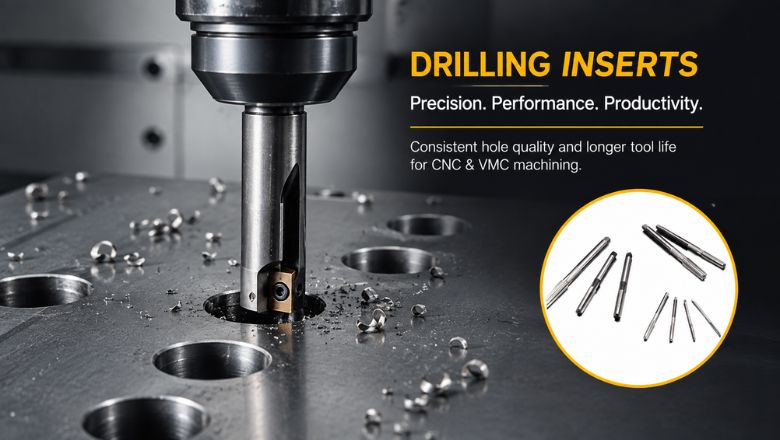
Drilling Inserts: Precision Cutting Solutions for CNC & VMC Machining
In modern CNC and VMC machining, achieving consistent hole quality depends heavily on the cutting tool used during the operation. Drilling Inserts are replaceable cutting components designed for indexable drilling tools, helping manufacturers perform repeatable hole-making operations across different metals and machining conditions.
Unlike a conventional solid drill, an indexable drilling system uses a reusable drill body with replaceable inserts. When a cutting edge wears, the insert can be indexed or replaced without changing the complete tool body. Depending on the drill design, different insert positions can also perform different cutting functions. For manufacturers looking for reliable Drilling Inserts, choosing the right insert specification is essential for achieving consistent machining results across different CNC and VMC applications.
For manufacturers looking for reliable Drilling Inserts in India, the important consideration is not simply the insert price. Material grade, insert geometry, coating, chip control, hole diameter, cutting conditions, and machine capability all influence actual machining performance.
What Are Drilling Inserts?
Drilling Inserts are precision-engineered cutting tips mounted on an indexable drill body or drilling head. They are commonly manufactured from carbide and may feature specialized coatings and chipbreaker geometries for particular machining applications.
During drilling, the insert removes material from the workpiece while the drill body provides the required support and cutting geometry. Once an edge reaches its usable wear limit, the insert can be replaced or indexed, reducing the need to replace the complete drill assembly.
Indexable drilling systems are commonly used for medium- and large-diameter hole-making, production machining, and applications where repeatability and efficient tool changes are important.
Which Drilling Insert Is Right for Your Application?
Selecting the correct drilling insert starts with understanding the workpiece and machining conditions. An insert designed for steel may not deliver the same performance when used on stainless steel, cast iron, or non-ferrous materials.
1. Carbide Drilling Inserts :
Carbide is widely used for industrial drilling because of its hardness, wear resistance, and ability to withstand demanding cutting conditions. Carbide insert grades and geometries can be selected according to the workpiece material and required cutting performance. For applications where a solid cutting tool is more appropriate, manufacturers can also explore HSS Drill Bits based on the workpiece material and drilling requirements.
2. Indexable Drilling Inserts :
Indexable inserts are designed for drill bodies that use replaceable cutting edges. This configuration is particularly useful in production environments because the drill body can remain in service while worn cutting edges are changed.
3. Coated Drilling Inserts :
Coatings such as TiAlN and other engineered coating systems are used on drilling inserts for specific machining requirements. The appropriate coating depends on the workpiece, cutting conditions, and insert grade. Industrial insert catalogues commonly specify coating, grade, corner radius, and applicable material together, showing why insert selection should be application-specific.
Drilling Inserts for Different Materials :
The workpiece material is one of the first parameters to consider when selecting an insert.
Mild and carbon steel: A general-purpose carbide grade and suitable chipbreaker can be selected according to cutting speed, feed, and hole depth.
Stainless steel: Stainless steel generates heat and can create challenging chip-formation conditions. An insert geometry designed for stainless-steel drilling can help maintain stable cutting performance.
Cast iron: The abrasive nature of cast iron requires suitable wear-resistant grades and edge preparation.
Aluminium and non-ferrous metals: Positive cutting geometries and appropriate chip control are important for efficient material removal and preventing chip-related problems.
Hard alloys and superalloys: These applications generally require specialized grades, coatings and geometries rather than a standard general-purpose insert.
Major cutting-tool catalogues classify drilling inserts according to material groups such as steel, stainless steel, cast iron, aluminium/non-ferrous materials and high-temperature alloys.
Why Insert Geometry Matters in CNC Drilling :
Two inserts with similar dimensions can behave differently because their geometry is not identical. Cutting-edge angle, corner radius, chipbreaker design, thickness, and coating can influence cutting forces, chip formation, tool wear, and hole quality. Insert geometry and chipbreaker selection should therefore be matched to the machining application, as explained in professional cutting-tool technical guidance.
For example, chipbreaker designs are often developed for particular feed ranges or workpiece materials. Some indexable drilling insert families are specifically offered with geometries for general drilling, stainless steel, or different feed conditions.
This is why choosing an insert solely by its physical size can lead to inconsistent machining results.
Drilling Inserts for CNC and VMC Machines :
CNC and VMC machines demand repeatable tooling because production components may require hundreds or thousands of similar holes. A properly matched drilling insert can help maintain consistent cutting conditions throughout the production cycle.
For CNC/VMC machining, manufacturers should consider:
- Workpiece material and hardness
- Hole diameter and depth
- Through-hole or blind-hole application
- Machine spindle speed and power
- Coolant availability
- Required hole tolerance
- Feed rate and cutting speed
- Chip evacuation requirements
- Drill body and insert compatibility
The insert must also match the specific drill body. In indexable drilling systems, center and peripheral inserts may have different functions and are not necessarily interchangeable.
Drilling Insert Selection: What Should You Check?
Before purchasing Drilling Inserts, verify the complete specification rather than selecting only by brand or price.
Check the insert designation, cutting-edge length, thickness, inscribed circle, corner radius, grade, coating, chipbreaker, and applicable material group. These specifications are commonly listed in professional cutting-tool catalogues and are essential for matching the insert to the intended drilling system.
For production users, another important factor is availability. A technically suitable insert provides little value if replacement inserts are difficult to source when production is running. If you need a more detailed approach to insert selection, our guide on how to choose the right insert for better machining performance covers the key factors that should be evaluated before selecting an insert.
Drilling Inserts Supplier in India :
For manufacturers, engineering workshops and CNC/VMC users, working with an experienced cutting-tool supplier can simplify insert selection and replacement planning.
Jay Tech Tools supplies drilling and machining tooling solutions for industrial applications, with a focus on precision cutting tools for CNC and VMC operations. Customers looking for Drilling Inserts in Ahmedabad, Gujarat, and across India can discuss their workpiece material, machine type, drill body, hole size, and machining requirements to identify a suitable insert specification.
The right drilling insert is ultimately a combination of correct grade + geometry + application + machining parameters, rather than a one-size-fits-all product.
Get the Right Drilling Inserts for Your Application :
Need reliable Drilling Inserts for CNC or VMC machining?
Choose the right grade, geometry, and specification with Jay Tech Tools. Explore our range of precision drilling inserts for CNC and VMC machining and find a suitable solution for your production requirements.
Contact Jay Tech Tools today for the right drilling insert for your machining requirements.
FAQs :
What are Drilling Inserts used for in CNC machining?
Drilling Inserts are replaceable cutting components used in indexable drilling tools to produce accurate holes in metal workpieces. They are commonly used in CNC and VMC machining where consistent hole production, controlled cutting performance, and efficient insert replacement are important.
How do I choose the right Drilling Insert for my application?
The correct Drilling Insert should be selected according to the workpiece material, hole diameter, hole depth, drill body, cutting speed, feed rate, coolant condition, insert geometry, grade, and coating. Selecting an insert based only on size or price may result in unsuitable machining performance.
Which Drilling Inserts are suitable for steel and stainless steel?
Different insert grades and geometries may be required for steel and stainless steel. Steel applications commonly use suitable carbide grades and chipbreaker geometries, while stainless steel may require an insert designed to handle higher heat generation and difficult chip formation. The final selection should match the machining conditions and material grade.
Are carbide Drilling Inserts suitable for CNC and VMC machines?
Yes. Carbide Drilling Inserts are widely used for industrial CNC and VMC machining because carbide provides high hardness and wear resistance. However, the appropriate carbide grade, geometry, and coating should be selected according to the workpiece and machining parameters rather than assuming one grade is suitable for every application.
What is the difference between indexable and conventional drilling tools?
An indexable drilling tool uses a drill body with replaceable cutting inserts, whereas a conventional solid drill has its cutting edges integrated into the tool. With an indexable system, worn inserts can be replaced without replacing the complete drill body, making the system particularly useful for production machining.
Why is insert geometry important when selecting a Drilling Insert?
Insert geometry affects chip formation, cutting forces, edge strength, heat generation, tool wear, and hole quality. Chipbreaker design, cutting-edge geometry, corner radius, and insert thickness should therefore be matched to the workpiece material and machining conditions.
Can the same Drilling Insert be used for aluminium, steel, and stainless steel?
Not always. Different materials have different cutting characteristics and may require different insert grades, geometries, and coatings. For example, an insert suitable for steel may not provide the desired chip control or cutting behaviour when used for aluminium or stainless steel.
What specifications should I check before buying Drilling Inserts?
Before purchasing, check the insert designation, dimensions, thickness, corner radius, grade, coating, chipbreaker, cutting-edge configuration, drill-body compatibility, and recommended material group. These details help ensure that the insert matches the intended drilling system and machining application.
Where can I buy reliable Drilling Inserts in India?
Industrial buyers can source Drilling Inserts from specialized cutting-tool suppliers such as Jay Tech Tools. Before purchasing, provide details such as the workpiece material, hole diameter, hole depth, machine type, drill body, and machining requirements so the appropriate insert specification can be identified.
How can Jay Tech Tools help with Drilling Insert selection?
Jay Tech Tools provides drilling and machining tooling solutions for CNC and VMC applications. Instead of selecting an insert only by price or appearance, customers can discuss their material, hole size, machine, drill body, and machining requirements to identify a suitable Drilling Insert specification for their application.